
Polk County Criminal Court Cases
Florida divides Polk County criminal court cases by charge level. The Circuit Court of the Tenth Judicial Circuit hears felony prosecutions. Polk County Court hears misdemeanors and county-level criminal traffic matters. The Tenth Circuit also serves Highlands and Hardee counties, so the county and division shown on a result matter. Lakeland, Winter Haven, and Auburndale do not maintain separate municipal criminal dockets. Their police cases move into this state trial-court structure.
The Polk County Clerk of the Circuit Court and Comptroller is the custodian of pleadings, docket entries, hearing records, judgments, and sentencing orders. The sheriff keeps booking and incident material, not the prosecution file. A booking charge may change before the State Attorney files a charging document. The Polk County court record is therefore the better source for what prosecutors alleged and how each count ended.
Inside Polk County Criminal Case Search
The Clerk’s criminal court records page leads to the current Polk County case system. It replaces the criminal route once associated with the legacy Polk Records Online portal. That older portal now directs criminal users elsewhere. Starting at the Clerk’s current landing page helps avoid searching a civil and official-record database for a criminal docket that it does not hold.
The official Clerk page shown below is the recovery point if a saved search URL changes. It also keeps the request tied to the office that can issue a certified disposition.
View the Clerk’s criminal case access page.
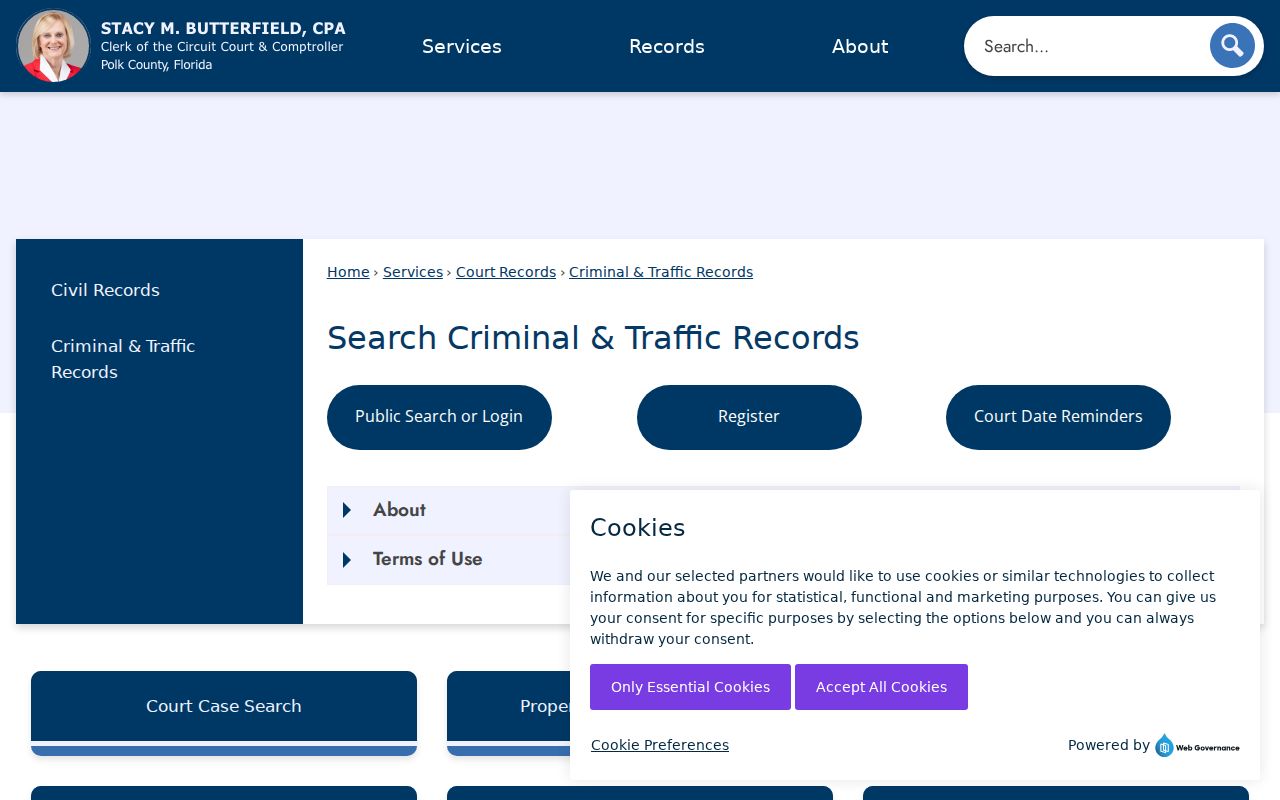
The page separates Polk County trial records from civil searches and gives readers a stable route back to current criminal access.
Searching Polk County Case Records
Use a full case number when available. It is more precise than a name, especially when several people share a surname. Name searches still help when the number is unknown. Compare the county, division, filing year, and party details before opening a docket. A blank result does not prove that no Polk County criminal court case exists. Spelling, restricted access, sealing, a recent filing, or the wrong case type can all explain a miss.
- Open the Clerk’s criminal records page and enter the dedicated criminal case system.
- Search by case number, or use the defendant’s last and first names.
- Narrow the result with the filing year, date of birth when offered, and criminal case type.
- Open the docket and read every count, event, and disposition instead of relying on the first charge.
- Ask the Clerk for the judgment, sentence, or a certified disposition when the online entry is not enough.
| Field | Format | Required | Best Use |
|---|---|---|---|
| Last name | Text | No | Broad party search when no case number is known |
| First name | Text | No | Narrows common surnames |
| Case number | Text | No | Most direct route to one Polk County court file |
| Date of birth | Date | No | Helps distinguish similar names when displayed |
| Case type or year | Filter | No | Separates felony, misdemeanor, and criminal traffic results |
Polk County Felony Case Files
Polk County case numbers help identify the court track. Research records the local abbreviations CF for Circuit felony, MM for County misdemeanor, and CT for criminal traffic. Those codes point to case type, not guilt. A filed felony case belongs in Circuit Court. A misdemeanor or qualifying criminal traffic matter belongs in County Court. The docket may show a transfer, amended charge, or related case, so read the event list before treating the original code as the final result.
Plain terms: CF means Circuit felony, MM means County misdemeanor, and CT means criminal traffic in Polk County case numbering.
The State Attorney for the Tenth Judicial Circuit decides which charges to file. Defense representation may come through the Tenth Circuit Public Defender. Neither office replaces the Clerk as custodian of the filed court record.
Inside a Polk County Case File
A Polk County criminal case file is a procedural record. It connects the formal charge to court events and the outcome. A docket sheet provides the chronology, while the judgment and sentence or dismissal order supplies the adjudicated result. Multi-count cases require count-by-count review because one count may be dismissed, another amended, and another resolved by plea or trial.
| Case number and court | Identifies the Polk division, filing year, and trial-court track. |
|---|---|
| Charging document | Shows the offense or offenses formally filed by the prosecution. |
| Docket entries | List filings, hearings, motions, pleas, continuances, and orders in date order. |
| Hearing dates | Show scheduled and completed court settings, subject to later change. |
| Disposition and judgment | Record how each count ended, including dismissal, plea, trial result, withhold, or adjudication. |
| Sentence and conditions | May show confinement, supervision, costs, fines, treatment, or other court-ordered terms. |
Reading Polk County Case Outcomes
“Closed” does not mean “convicted.” It means the case is no longer active in the same way, and the disposition entry must explain why. Nolle prosequi means the prosecutor chose not to proceed on a charge. A dismissal ends a count without a conviction on that count. A withhold of adjudication is not the same entry as an adjudication of guilt, though it can still carry conditions and legal effects.
- Arraignment
- The hearing where the filed charge is presented and a plea is entered.
- Nolle prosequi
- A prosecutor’s decision not to continue a filed charge.
- Withhold
- A disposition in which the court withholds formal adjudication while imposing authorized terms.
- Adjudication
- The court’s formal judgment on guilt after a plea or trial.
- Capias
- A court-issued command directing that a person be taken into custody.
Costs are also distinct from a criminal fine. The Polk docket can list service charges, court costs, restitution, and fines as separate obligations. Read the sentencing order for the controlling terms.
How a Criminal Case Moves
An arrest starts the local record chain, but the court case begins when charges are filed. The State Attorney may file a different charge from the booking allegation, decline a charge, or divide conduct into several counts. Arraignment follows filing. Pretrial work can add motions, discovery notices, continuances, and negotiated plea documents. A plea or trial produces a disposition, and sentencing may occur then or at a later hearing.
Case flow: Charges Filed › Arraignment › Pretrial › Plea or Trial › Disposition › Sentencing
This flow explains why a new Jail Inquiry entry may have no matching Clerk case yet. Booking staff and the court do different work on different schedules. For the underlying custody entry, use the Polk County arrest lookup; for the legal outcome, return to the court docket.
Restricted Polk County Case Documents
Florida’s open-court principle does not put every image online. Juvenile records, sealed or expunged matters, protected victim information, confidential identifiers, and some sensitive filings can be withheld or redacted. A public docket line may remain visible even when the linked image is unavailable. Online limits do not always describe what an eligible person may obtain at the counter.
When an image is restricted, note the Polk County case number, document title, and filing date. Contact the Clerk and ask whether a redacted copy, in-person inspection, or certified copy is available. Under the Florida Public Records Law, access still yields to statutory and court-rule exemptions. The Clerk can identify the proper request route but cannot give legal advice about eligibility.
Polk County Appeals and Federal Cases
The Polk Clerk system is for local trial matters. Florida appellate records use the courts’ Appellate Case Information System. A local prosecution can therefore have its trial docket in Polk County and a later appellate docket in ACIS. Search the trial case first to locate the notice of appeal and related lower-court number, then use those facts to match the appellate matter.
Federal prosecutions are separate again. Polk County lies within the U.S. District Court for the Middle District of Florida, and federal dockets are accessed through PACER. The official PACER interface below belongs to the federal layer, not to Polk County Circuit or County Court.
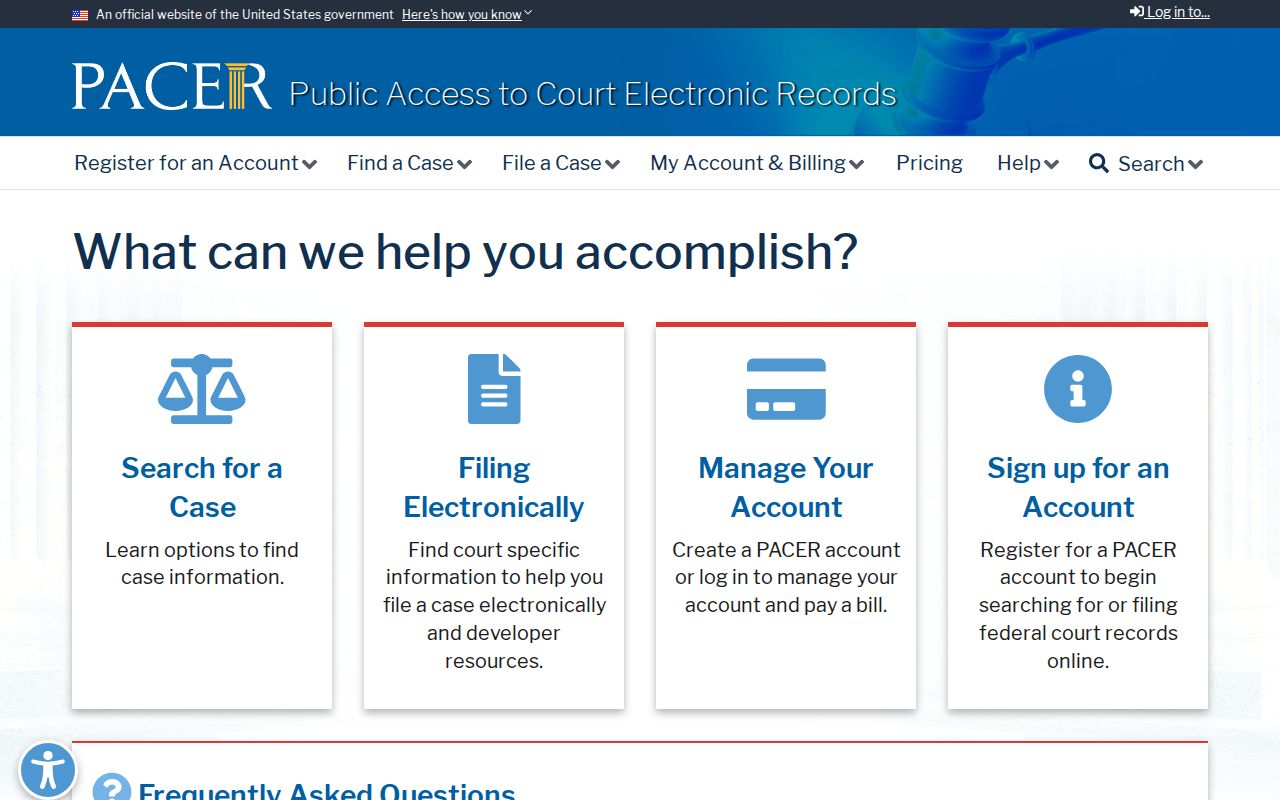
Keeping the systems separate prevents a missing federal result from being mistaken for a missing Polk County court file.
Polk County Drug Court Records
Florida Courts’ 2024 problem-solving court inventory lists Polk County’s adult post-adjudicatory prison-diversion drug court. It is a named local sentencing program, not a separate public case database. Program entries, status hearings, sanctions, and completion or termination events can appear within the underlying Polk County criminal docket.
Because the program is post-adjudicatory, a reader should not infer that participation erased the case. Check the judgment, sentencing terms, later review hearings, and final program order. The Florida Courts problem-solving courts program explains the statewide framework, while the Clerk file supplies the person-specific Polk record.
Case Record Access & Restrictions
The public may inspect many Polk County criminal court cases, yet access depends on the record and the requester. Sealed and expunged records are removed from ordinary public view. Juvenile files receive special protection. Victim details, Social Security numbers, financial account data, and other protected facts may be redacted. An absent online file can also reflect a recent filing or technical lag rather than a legal restriction.
For an official outcome, request the final disposition from the Clerk at the Polk County Courthouse, 255 North Broadway Avenue, Bartow, Florida 33830, or call 863-534-4000. The counter can address trial records, copies, and certification. It cannot supply a police narrative held by PCSO or a city department. Note: Ask for the judgment or certified disposition by name when a docket summary alone does not resolve the result.
The source image below shows the legacy Polk Records Online notice that now routes criminal users to the dedicated system.
Review the official legacy routing notice.
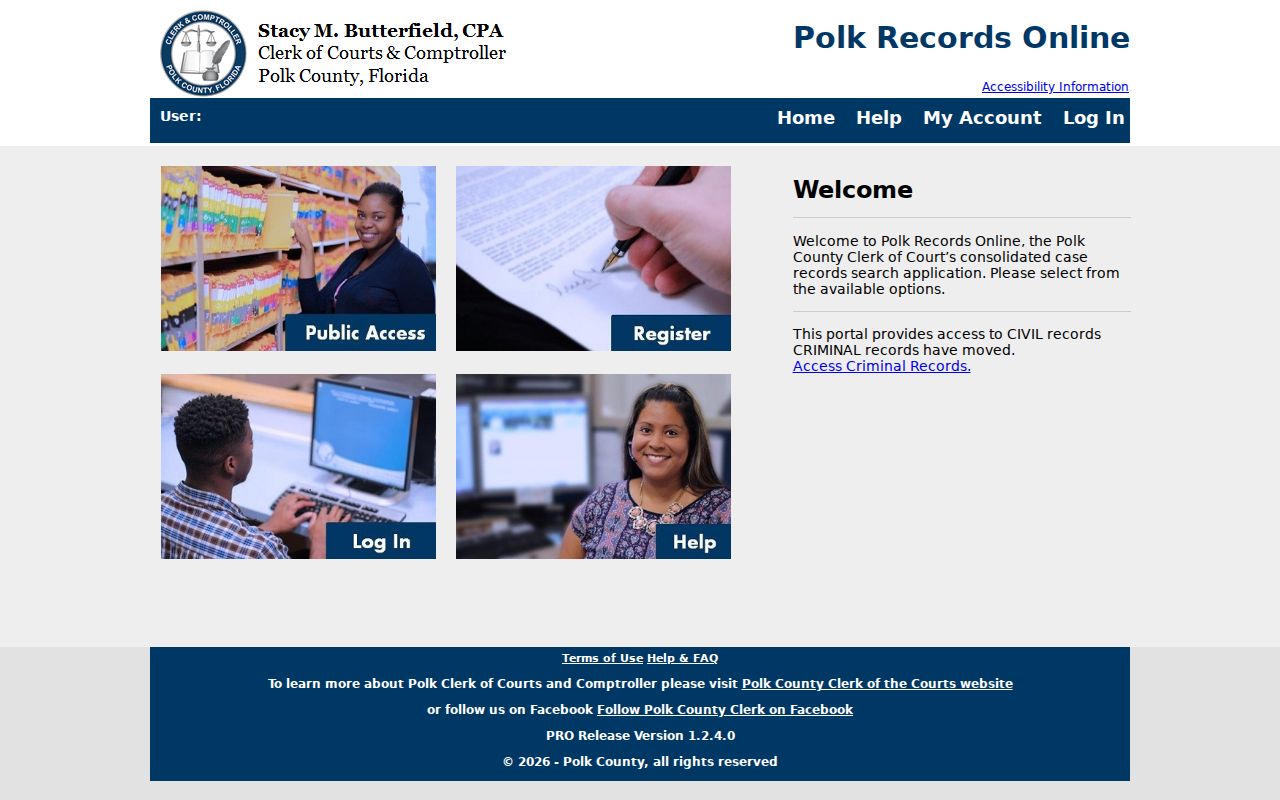
That notice is useful when an old bookmark lands on the wrong Polk Clerk product.